

2026 Mazda CX-5 vs. 2026 Toyota RAV4: An Honest Comparison for New Hampshire Drivers
Two of the best-selling compact SUVs in America both got torn down and rebuilt for 2026. That almost never happens in the same model year, and it makes this particular matchup a lot more interesting than the usual spec-sheet shuffle.
Toyota took the RAV4 somewhere genuinely bold. The gas-only version is gone. Every 2026 RAV4 sold in this country is a hybrid, and the entry price went up to $31,900 because of it. Mazda went the other direction with the CX-5. Longer wheelbase, bigger cabin, all-new Google-based infotainment, and the same naturally aspirated 2.5-liter four-cylinder it has been using for years, driving all four wheels through a real six-speed automatic.
One of these cars is chasing efficiency. The other is chasing the way a car feels from the driver's seat. Both are defensible. Neither is universally correct, and anybody who tells you otherwise is selling something.
We sell Mazdas. You know that going in. So we are going to be blunt about the places where the RAV4 beats the CX-5, because there are several and pretending otherwise would waste your time. Then we will tell you exactly who should buy which one.
Written by the sales and product team at Seacoast Mazda, Portsmouth, New Hampshire. Specifications pulled from Toyota's published 2026 RAV4 spec sheets and Mazda's 2026 CX-5 materials in July 2026.
Jump to a section
- The short version
- What changed for 2026
- Engines and power
- Fuel economy, and what it costs you
- Two very different all-wheel-drive systems
- Size, space and the wheelbase gap
- Cargo, where Toyota wins
- Interior, screens and the knob problem
- Price, trim by trim
- Full head-to-head chart
- How they drive on Seacoast roads
- Buy the RAV4 if...
- Buy the CX-5 if...
- Questions we actually get asked
The Short Version
If your decision comes down to a spreadsheet, the RAV4 wins. It is rated up to 41 mpg combined against roughly 26 for the CX-5. It makes 226 to 236 net combined horsepower against 187. It holds more cargo behind the back seat and it tows 3,500 pounds. Those are not small margins and no amount of brand loyalty erases them.
If your decision comes down to the twenty minutes you spend in the car every morning, the CX-5 makes a much stronger case. It starts $1,910 cheaper. It rides on a wheelbase almost five inches longer, which you feel on frost-heaved back roads. Its all-wheel drive is a real mechanical system with a center limited-slip differential rather than a rear electric motor that switches on after the fronts have already slipped. And it uses a conventional six-speed automatic instead of a CVT, which matters more than people expect once you have lived with both.
Our honest read: if you drive more than about 15,000 miles a year, buy the RAV4 and enjoy the fuel savings. If you drive a normal New Hampshire commute and you care how the car feels, the CX-5 is the better buy and it is not close.
What Actually Changed for 2026
Both of these are new cars, not facelifts, so throw out whatever you knew about the 2024 and 2025 versions.
The RAV4 went all-in on hybrid
This is the headline. Toyota killed the naturally aspirated gas-only RAV4 for the American market. What is left is a hybrid lineup starting at $31,900 and a plug-in hybrid starting at $41,500. The hybrid system pairs a 2.5-liter Dynamic Force four-cylinder running a 14:1 compression ratio with electric motors, and it is rated as a Super Ultra Low Emission Vehicle.
Toyota also added drive modes the old car did not have. You now get Sport, Eco, Normal, EV, Trail and Snow. The Snow mode in particular is a nice touch for anybody north of Boston.
The CX-5 got bigger and went Google
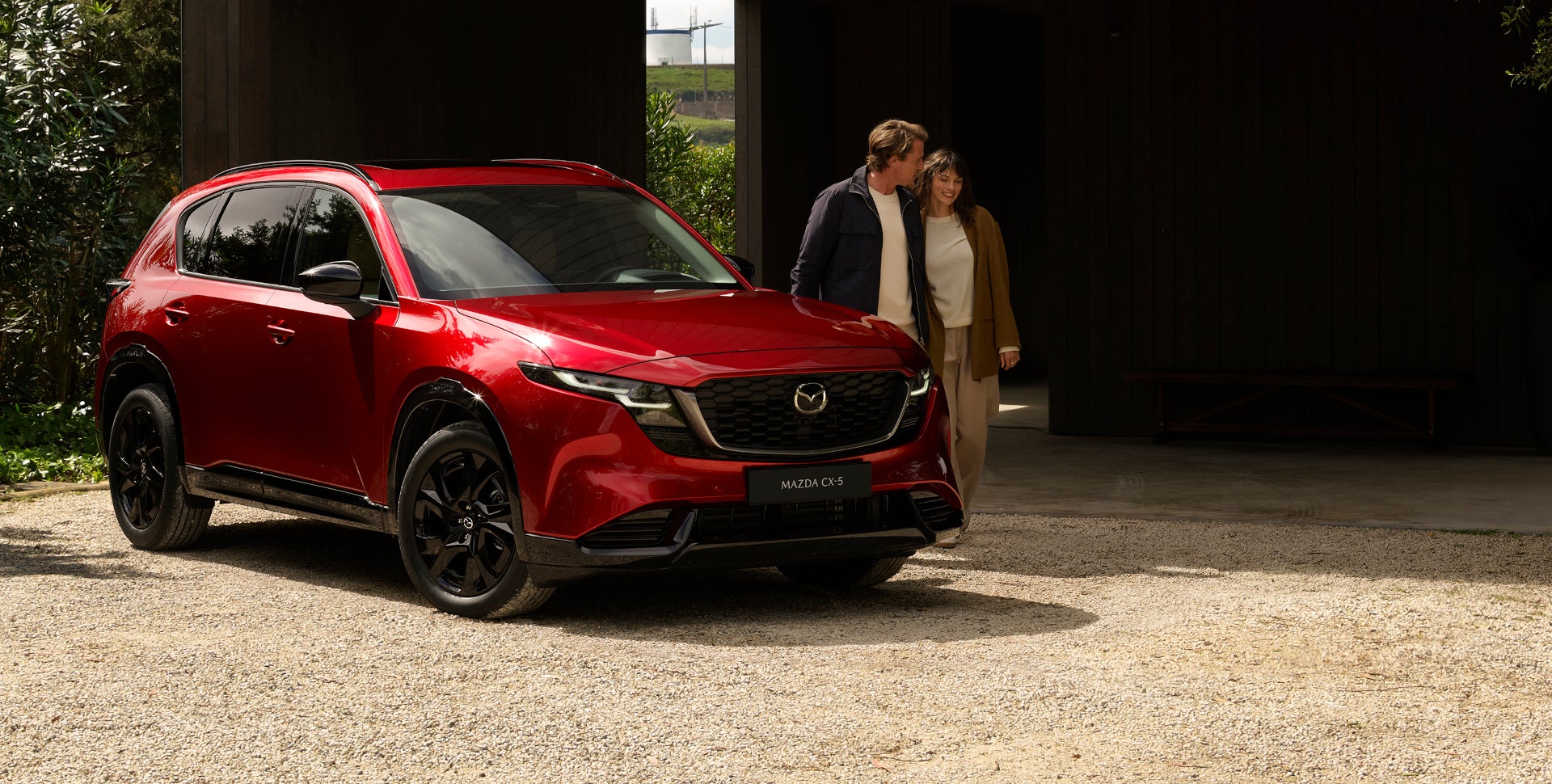
Mazda stretched the CX-5 to 184.6 inches long, up from 180.1. Width went up an inch to 73.2 inches without the mirrors, and height went to 66.7 inches without roof rails. The important number is the wheelbase, which grew 4.6 inches to 110.8 inches. Nearly all of that went into the back seat and the cargo floor.
Inside, the rotary command dial is gone. So is most of the physical switchgear. In its place is a 12.9-inch touchscreen running Google built-in, with Google Assistant, Google Maps and access to the Play Store. The top Premium Plus trim gets a 15.6-inch screen instead. We have thoughts about that, and we get to them below.
The rear end borrows its design language from the CX-70 and CX-90, there is a new Navy Blue Mica paint option, and Crystal Soul Red Metallic is back.
One Makes 187 Horsepower. The Other Makes 236.
Let us get the uncomfortable part out of the way. On paper the RAV4 wins this handily.
The CX-5 uses the SKYACTIV-G 2.5-liter naturally aspirated four-cylinder producing 187 horsepower at 6,000 rpm and 186 pound-feet of torque at 4,000 rpm. Power goes through a six-speed SKYACTIV-Drive automatic with a manual shift mode, and then to Mazda's i-Activ all-wheel drive, which is standard on every single trim.
The RAV4 hybrid makes 226 net combined horsepower in most configurations and 236 in others, and it delivers that through an electronically controlled CVT. The electric motors contribute 170 pound-feet of torque on their own, with 100 kW at the front and 40 kW at the rear.
Here is the part the numbers do not tell you. Hybrid torque arrives instantly, so the RAV4 feels quick pulling away from a light on Woodbury Avenue. Above about 45 mph that advantage flattens out, and the CVT starts doing the thing CVTs do, holding revs at a constant drone while the car gathers speed. Some people genuinely do not notice. Some people cannot stop noticing.
The CX-5's six-speed is not a technological marvel. Six ratios is fewer than most competitors offer and Mazda has been criticized for keeping it. But it shifts crisply, it holds a gear when you ask it to, and it never disconnects engine noise from road speed. If you have ever test-driven a CVT crossover and walked away feeling vaguely dissatisfied without being able to say why, that is the reason.
Fuel Economy, and What the Difference Actually Costs
This is the RAV4's trump card and we are not going to soften it.
The 2026 RAV4 is EPA-rated at 43 city, 37 highway and 41 combined on the Limited and XSE with all-wheel drive. The more rugged Woodland trim comes in at 41 city, 35 highway and 38 combined. The 2026 CX-5 with all-wheel drive is rated 24 city and 30 highway, which works out to roughly 26 combined.
That is a gap of about 15 mpg. Real money. Let us do the math instead of hand-waving at it.
At 12,000 miles a year and $3.20 a gallon, the CX-5 burns about 462 gallons and costs you roughly $1,477 in fuel. The RAV4 burns about 293 gallons and costs about $937. You save around $540 a year with the Toyota.
Now compare the cars people actually cross-shop. A CX-5 2.5 S Premium is $36,900. A RAV4 XSE is $41,300. That is $4,400 more up front to save $540 a year, so you are looking at roughly eight years to break even on fuel alone. Compare base to base and the gap narrows a lot: $29,990 against $31,900 is $1,910, which pays back in under four years.
So the fuel argument is real, but it depends enormously on which trims you are comparing and how much you drive. Twenty-five thousand miles a year changes the answer completely. Nine thousand miles a year changes it the other way.
Two Systems Both Called All-Wheel Drive
This is the part most comparison articles skip, and in New Hampshire it might matter more than fuel economy.
The CX-5 uses i-Activ AWD, a mechanical system with a driveshaft running to the back axle and a center limited-slip differential. It is standard equipment on every trim, which is why there is an AWD badge on the tailgate of every one Mazda builds. The system monitors wheel loads, steering angle, wiper activity and outside temperature, and it shifts torque rearward before the front wheels lose grip rather than after.
The RAV4 does it differently. Its all-wheel drive comes from an electric motor mounted on the rear axle, rated at 40 kW. There is no driveshaft. When the fronts start to slip, the rear motor spins up. Toyota calls it All-Wheel Drive Integrated Management, and it works well, especially with Snow mode engaged.
Which is better depends on the situation. Pulling out of an unplowed driveway in Rye or climbing the hill on Route 108 in freezing rain, the mechanical system's proactive behavior is genuinely reassuring. On packed snow at steady speed, honestly, you would struggle to tell them apart. The electric setup also has one clear advantage: it responds in milliseconds because it is not waiting on a clutch pack.
What we will say is this. If you have ever owned a crossover whose all-wheel drive felt like it showed up late to the party, the CX-5's system will feel like an upgrade. Also worth noting: the RAV4 has more ground clearance, at 8.1 inches, or 8.5 on the Woodland.
Size, Space, and the Wheelbase Nobody Talks About
The CX-5 is now the bigger car in every exterior dimension except ground clearance, and the margin in one specific measurement is large enough to change how the car rides.
Overall length is 184.6 inches for the Mazda against 181 for the RAV4, or 182 for the Woodland. Width is 73.2 against 73. Height is 66.7 against 66.5. Those are rounding errors.
Wheelbase is not a rounding error. The CX-5 sits on 110.8 inches. The RAV4 sits on 105.9. That is a difference of 4.9 inches, and it is the single most consequential number in this whole comparison.
A longer wheelbase means the front and rear axles hit a bump further apart in time, which smooths out the pitching motion you feel over expansion joints and frost heaves. Anybody who has driven Route 4 toward Northwood in March knows exactly what we mean. It also means more room between the seats. Mazda put nearly all of that extra length into second-row leg, knee and headroom.
The RAV4 is not cramped. It offers 41 inches of front legroom and 37.8 in the second row, with 98.9 cubic feet of EPA passenger volume, and it has a tighter 18-foot turning radius that makes it easier to park behind Market Square. But the CX-5 simply gives rear passengers more space to sit in.
Cargo: Toyota Wins This One
We said we would be straight with you, so here it is.
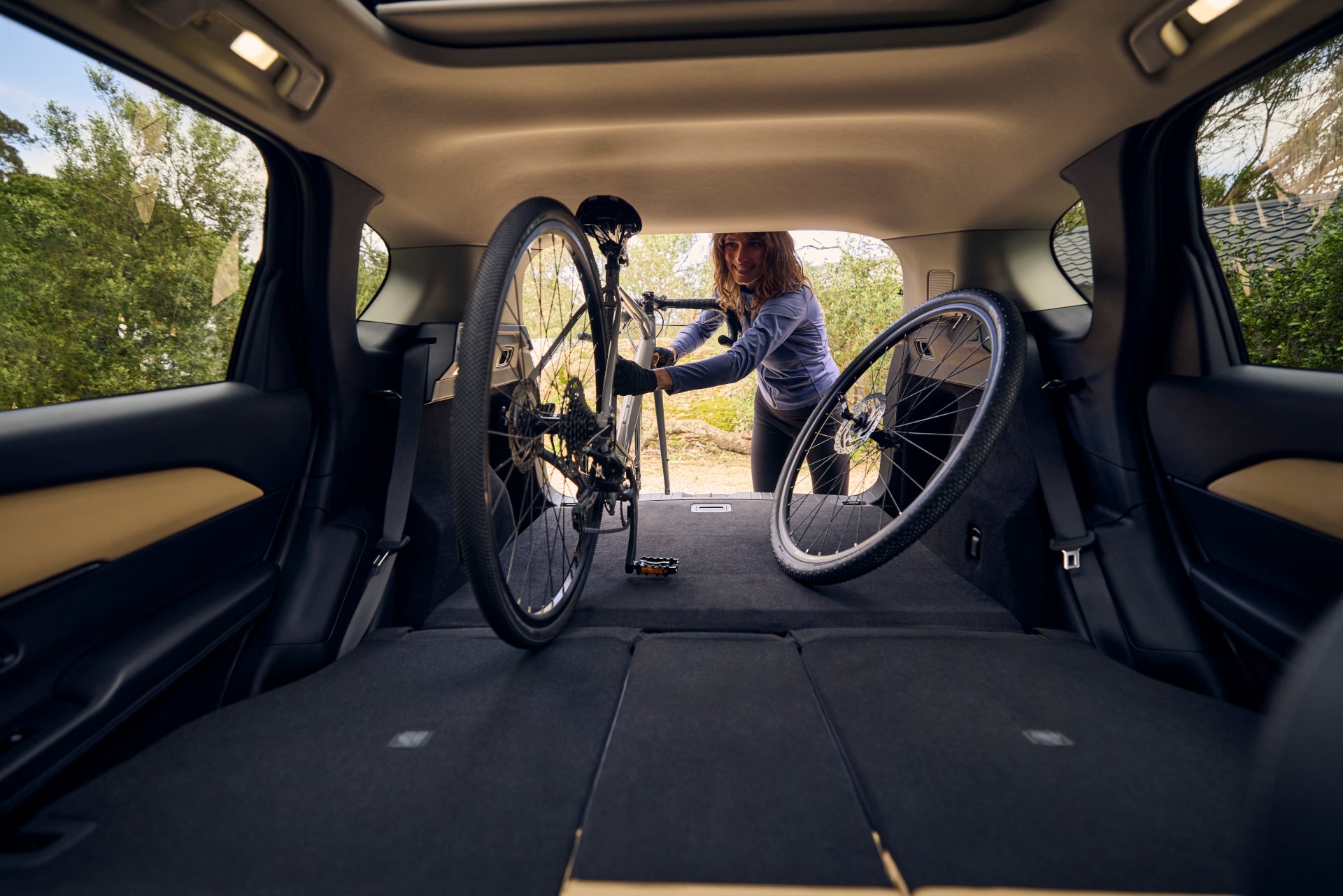
The RAV4 holds 36.6 cubic feet behind the rear seat on the Limited and 37.8 on the Woodland and XSE. The CX-5 holds 33.7. Toyota gives you roughly three to four cubic feet more in the space most people actually use, which is the difference between the stroller fitting next to the grocery bags and not.
Mazda's answer is the seats-down number, where the CX-5 opens up to 66.5 cubic feet, and a lower load floor with a wider tailgate opening that makes awkward items easier to slide in. The 40/20/40 split rear seatback folds with one touch and reclines. That center pass-through is genuinely useful for skis with four people aboard, and the RAV4 does not offer the same arrangement.
Towing is another Toyota win. The RAV4 is rated at 3,500 pounds. If you pull a small boat out of Great Bay or haul a utility trailer to the dump in Stratham, that number matters, and the CX-5 does not match it. Ask us for the current CX-5 rating before you buy if towing is part of your life.
Inside: Materials, Screens, and the Knob Problem
Mazda has spent a decade building interiors that punch above the sticker price, and the 2026 CX-5 continues that. Higher-grade materials than before, a genuinely handsome layout, leather-wrapped wheel and shifter even on the base car, and available Sport Tan leather that looks like it belongs in something costing $15,000 more. The Bose 12-speaker system with Centerpoint and AudioPilot on the Premium trim is a real audio system, not a badge.
Standard equipment on every CX-5 includes a 10.25-inch digital instrument display, dual-zone climate, push-button start, rain-sensing wipers, and the full i-Activsense driver assistance suite with ten airbags. Move up to the 2.5 S Preferred and you get heated front and rear seats, a heated steering wheel, a windshield wiper de-icer and a power liftgate, which is the trim we point most New Hampshire buyers toward for obvious reasons.
The RAV4's cabin is more utilitarian and it makes no apology for it. Hard-wearing surfaces, controls exactly where you expect, nothing precious about any of it. For a lot of families that is the right answer.
Screens
The CX-5 gives you a 12.9-inch touchscreen as standard, or 15.6 inches on Premium Plus. The RAV4 starts with a 10.5-inch unit and six speakers, with a 12.9-inch available and a 9-speaker JBL system at the top. Both offer wireless Apple CarPlay and Android Auto. Advantage Mazda on standard screen size, clearly.
Now the criticism
Mazda moved the climate controls into the touchscreen and deleted the rotary dial. We think that is a mistake and we will say so on our own website. The old commander knob let you change tracks or adjust the map without taking your eyes off the road, and it was one of the genuinely differentiated things about owning a Mazda. Reaching for a menu to change fan speed with gloves on in February is worse. Google built-in is excellent software and Google Maps on a 12.9-inch screen is a real upgrade over the old Mazda Connect system, but it came at a cost.
If physical buttons matter a lot to you, drive both before you decide. This is a preference thing and you will know within five minutes.
Price, Trim by Trim
Both lineups climb quickly, but they climb differently. Every CX-5 includes all-wheel drive in the price shown. Every RAV4 is a hybrid.
| Trim | Starting MSRP | What it adds |
|---|---|---|
| 2.5 S | $29,990 | 17-inch alloys, 12.9-inch screen, i-Activsense, AWD |
| 2.5 S Select | $31,900 | Heated mirrors, leatherette, wireless charger, radar cruise with stop and go |
| 2.5 S Preferred | $34,250 | Heated front and rear seats, heated wheel, wiper de-icer, power liftgate, 19-inch wheels |
| 2.5 S Premium | $36,900 | Panoramic moonroof, ventilated seats, leather, Bose 12-speaker |
| 2.5 S Premium Plus | $38,990 | 15.6-inch screen, adaptive front lighting, driver personalization |
| Trim | Starting MSRP | EPA combined |
|---|---|---|
| RAV4 Hybrid (entry) | $31,900 | up to 41 mpg |
| Woodland AWD | $39,900 | 38 mpg |
| XSE AWD | $41,300 | 41 mpg |
| Limited AWD | $43,300 | 41 mpg |
| RAV4 Plug-in Hybrid | $41,500 | n/a |
Look at the top of each column. A loaded CX-5 Premium Plus with a 15.6-inch screen, adaptive headlights, ventilated leather and a Bose system lands at $38,990. A RAV4 Limited is $43,300. That is $4,310 apart, and the Mazda is the better-appointed car at that price.
Full Head-to-Head Chart
| Specification | 2026 Mazda CX-5 | 2026 Toyota RAV4 |
|---|---|---|
| Starting MSRP | $29,990 | $31,900 |
| Powertrain | 2.5L naturally aspirated 4-cyl | 2.5L hybrid, no gas-only option |
| Horsepower | 187 hp @ 6,000 rpm | 226 to 236 net combined hp |
| Torque | 186 lb-ft @ 4,000 rpm | 170 lb-ft from electric motor |
| Transmission | 6-speed automatic, manual mode | eCVT with sequential shift mode |
| All-wheel drive | Standard mechanical i-Activ AWD with center LSD | Electric rear motor, 40 kW |
| EPA fuel economy | 24 city / 30 hwy | 43 / 37 / 41 combined |
| Length | 184.6 in | 181 in |
| Wheelbase | 110.8 in | 105.9 in |
| Height | 66.7 in | 66.5 in |
| Cargo behind rear seat | 33.7 cu ft | 36.6 to 37.8 cu ft |
| Max cargo | 66.5 cu ft | See dealer |
| Towing | Below RAV4 rating, ask us | 3,500 lb |
| Ground clearance | See dealer | 8.1 in, 8.5 on Woodland |
| Standard touchscreen | 12.9 in, 15.6 available | 10.5 in, 12.9 available |
| Premium audio | Bose 12-speaker | JBL 9-speaker |
| Fuel tank | See dealer | 14.5 gal |
| Seating | 5 | 5 |
How They Actually Drive Around Here
Specs are specs. Here is what a week with each one feels like on roads we drive every day.
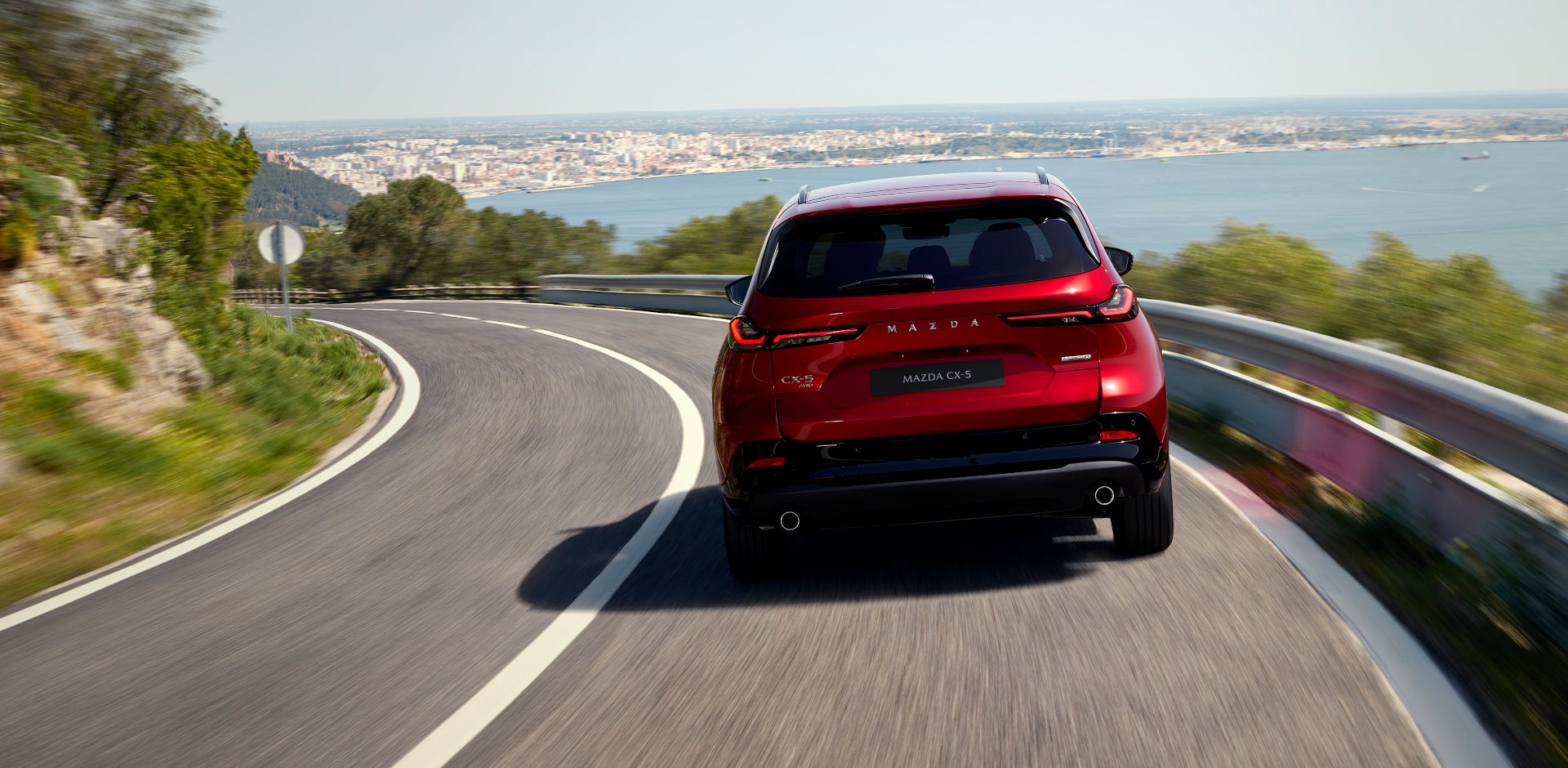
Take the CX-5 down Route 1A through Rye on a clear morning and the steering is the first thing you notice. It weights up naturally, it does not have that numb on-center vagueness most crossovers ship with, and the car settles into a corner instead of leaning on the outside tire and waiting. Mazda has been doing this for years and the longer wheelbase has not dulled it.
Put the same car on I-95 north toward Portland and the cabin is quiet, the six-speed sits in top gear and stays there, and the engine is doing about what you would expect. It is not fast. Merging onto 95 from Exit 5 with four people and luggage, you will use most of the 187 horsepower. That is honest.
The RAV4 does the opposite. Around town it feels effortless, gliding away from stops on electric torque, occasionally running on battery alone in traffic on Islington Street. The fuel gauge barely moves. It is genuinely impressive and the reason RAV4s sell in the numbers they do.
Ask it to do something enthusiastic and it politely declines. The steering tells you less, the body moves more, and the eCVT flares the revs. On the Spaulding Turnpike at 70 the RAV4 is perfectly composed. On a back road toward Durham it is transportation.
Ride quality is closer than the wheelbase numbers suggest, though the CX-5 has the edge on broken pavement. Frost heave season on Route 4 is where the extra 4.9 inches earns its keep.
Buy the RAV4 If
- You drive a lot. Fifteen thousand miles a year or more and the fuel savings become the whole argument.
- You tow. 3,500 pounds is a real capability and the CX-5 does not match it.
- You need maximum cargo behind the rear seat without folding anything down.
- Your driveway or camp road demands ground clearance, particularly the 8.5 inches on the Woodland.
- You want a plug-in option, which Mazda does not offer on the CX-5.
- You genuinely do not care how a car feels to drive, and there is nothing wrong with that.
Buy the CX-5 If
- You drive a normal commute. Under about 12,000 miles a year and the payback math stops favoring the hybrid.
- You want all-wheel drive standard without climbing a trim ladder to get it.
- Rear-seat space matters. That 4.9-inch wheelbase advantage goes straight to your passengers.
- You want the nicer interior. At every price point the Mazda has better materials, and it is not close at the top of the range.
- You dislike CVTs. If you have driven one and it bothered you, this is your answer.
- You want a bigger standard screen. 12.9 inches against 10.5 is a meaningful daily difference.
- Your budget tops out around $39,000 and you still want everything. Premium Plus is loaded for $38,990.
Questions We Actually Get Asked
Is the 2026 Toyota RAV4 only available as a hybrid?
Yes. For 2026 Toyota dropped the gas-only RAV4 in the United States. Every 2026 RAV4 is either a hybrid, starting at $31,900, or a plug-in hybrid starting at $41,500. If you specifically want a non-hybrid compact SUV, the CX-5 is one of the remaining choices in the segment.
Does the 2026 Mazda CX-5 come with all-wheel drive standard?
Every 2026 CX-5 sold here includes i-Activ all-wheel drive at no extra charge, which is why there is an AWD badge on the tailgate of all of them. It is a mechanical system with a center limited-slip differential rather than an electric rear motor.
Which one is cheaper, the CX-5 or the RAV4?
The CX-5 starts lower, at $29,990 against $31,900, and the gap widens at the top of the range. A fully loaded CX-5 Premium Plus is $38,990 while a RAV4 Limited is $43,300.
How much better is the RAV4 on gas?
Substantially. The RAV4 is rated up to 43 city, 37 highway and 41 combined. The CX-5 with all-wheel drive is rated 24 city and 30 highway, roughly 26 combined. At 12,000 miles a year and $3.20 a gallon that is about $540 a year in Toyota's favor.
Which has more cargo space?
The RAV4, behind the rear seat, at 36.6 to 37.8 cubic feet against the CX-5's 33.7. The CX-5 counters with 66.5 cubic feet once the 40/20/40 seatback is folded, plus a center pass-through the RAV4 does not offer.
Is the CX-5 bigger than the RAV4?
In most exterior dimensions, yes. The CX-5 is 184.6 inches long against 181, and rides on a 110.8-inch wheelbase against 105.9. That wheelbase difference is the one you feel, both in ride quality and in rear-seat room.
Which is better in New Hampshire winters?
Both are competent. The CX-5's mechanical all-wheel drive engages before the front wheels slip and includes a windshield wiper de-icer plus heated rear seats from the Preferred trim up. The RAV4 has more ground clearance at 8.1 inches and a dedicated Snow drive mode. If deep unplowed driveways are your reality, the extra clearance is worth considering.
Does the 2026 CX-5 still have the rotary controller knob?
No. Mazda removed it and moved most controls, including climate, into the new Google-based touchscreen. We think that is a step backward for usability and we recommend you drive one before deciding whether it bothers you.
Can I drive both back to back?
Yes, and we encourage it. We are on Route 1 in Portsmouth and there is a Toyota store nearby, so plan an afternoon and take both over the same roads. That is the only way to settle the CVT question for yourself.
Keep Reading
- Explore the 2026 Mazda CX-5 near Portsmouth, NH
- 2026 Mazda CX-5 trim levels and specs
- CX-5 Select vs. Preferred: which trim is the value pick
- 2026 Mazda CX-5 vs. Honda CR-V
- 2026 Mazda CX-5 vs. Hyundai Tucson
- Prefer something more rugged? 2026 CX-50 vs. RAV4
- Pre-owned Mazda CX-5 inventory
- All Mazda model research
Where Our CX-5 Customers Come From
We are on Route 1 in Portsmouth, which puts us within a reasonable drive of most of the Seacoast, southern Maine and the North Shore. Customers regularly come to us from:
New Hampshire Seacoast: Portsmouth, Rye, New Castle, Greenland, Newington, North Hampton, Hampton, Hampton Falls, Seabrook, Stratham, Exeter, Newfields, Newmarket, Durham, Lee, Madbury, Dover, Somersworth, Rollinsford, Barrington, Nottingham, Northwood, Epping, Brentwood, Kensington, East Kingston, Kingston, Danville, Fremont and Raymond.
Central and southern New Hampshire: Rochester, Farmington, Milton, Wakefield, Concord, Manchester, Bedford, Goffstown, Hooksett, Derry, Londonderry, Windham, Salem, Pelham, Hudson, Nashua, Merrimack and Amherst.
Southern Maine: Kittery, Eliot, South Berwick, Berwick, York, Ogunquit, Wells, Kennebunk, Kennebunkport, Sanford and Saco.
North Shore Massachusetts: Amesbury, Newburyport, Salisbury, West Newbury, Georgetown, Rowley, Ipswich, Essex, Gloucester, Rockport, Manchester-by-the-Sea, Beverly, Danvers, Peabody, Salem, Marblehead, Swampscott, Lynn, Saugus, Wakefield, Reading, North Andover, Andover, Methuen, Haverhill, Boxford, Topsfield, Middleton and Wenham.
Drive Them Back to Back
Read every comparison you like, including this one. Then go drive both over the same twenty miles of road on the same afternoon, because the difference between these two cars is not something a chart can settle. The CVT either bothers you or it does not. The missing climate knob either bothers you or it does not. Nobody can answer that for you.
We keep 2026 CX-5 inventory on the ground in Portsmouth and we will happily hand you the keys without a sales pitch attached. Browse our current 2026 Mazda CX-5 inventory or call the store and we will have one ready when you get here.
Specifications, pricing and EPA estimates were accurate at the time of writing and are drawn from manufacturer-published materials. MSRP excludes destination, taxes, title and registration. Toyota and RAV4 are registered trademarks of Toyota Motor Corporation and this comparison is independent editorial content. Confirm current figures with us before purchase.